08 February 2009

2nd Regiment, of Horse.

Nickname "The Maggies"

Raised on 15 March 1704, from horsemen recruited in Poland, Russia and the Baltic Provinces. Service in the Arakun, Kimberlies, the Dead Heart, Poland (in Russian pay) and van Demon's Land, where the regiment was sorely hurt by a volly fired by the 8th Regiment of Foot. Brigaded with the 3rd Dragoons. Garrisoned at O'Donnell and Yass (2nd Squadron).

White coat, black facings, lace and shoulder strap, blackened cuirass (officers' with a silver parliamentary star at the top centre) with white trim, black leather cuirass straps (officers with silver plates), white metal buttons. Musicians wear red coats with black facings and six white inverted chevrons on the sleeves.
3rd Regiment, of Dragoons.

Nickname "The Sprinters"

Raised 15th March 1704 from former cavalrymen recruited in northern German states and Swedish Pommerania. Has served in western Germany (in French pay), the Eastern Marches and on the Marches Borders. Was severely handled by the 1st Horse at Blasthoffen (the 1st was then in the pay of a group of minor German princelings), where it gained its nickname. The feud with the 1st Horse continues and the Regiments are not to be deployed in the same theatre. Brigaded with the 2nd Horse. Garrisoned by squadron at O'Connell, Linlithgo, Port McQuarie and Taree.

Dark green coat, scarlet facings, light green shoulder strap, yellow metal buttons.
4th Regiment, of Dragoons.

Nickname "The Ponces"

Raised on 26 January 1713 from the sons of well to do personages in Ekaterinsburg and apprpriate volunteer gentlemen from the German states, France and the United Kingdom. This is the regiment in which the socially-aware young officer wishes to serve. The colonels and senior officers of this regiment are only drawn from the best families of the republic. Despite this, the regiment also has a very good combat record. This regiment is the only unit garrisoned in the capital. The Regiment has seen service in the Eastern Marches, The Darwin Rebellions of 1723 and 1728, the Arakun, Duchy of van Demon's Land, western Germany (in French pay) and southern Germany (in Austrian pay). The Regiment is not brigaded. Garrisoned in Ekaterinsburg.

Dark blue coat, crimson facings, mid blue shoulder strap, white metal buttons. Officers wear white leather, not crimson cloth, breeches, have silver lace on their button holes and belts and wear silver aigulettes on the right shoulder.
5th Regiment, of Dragoons.

Nickname "The Bruises"

Raised 24 December 1737 from former Austrian, Hannoverian and Wuerttemberg cavalrymen. Active service in the Eastern Marches (1st Squadron), Arunta Uprising and the Dead Heart. Brigaded with 1st Horse. Garrisoned at The Springs.

Black coat, mid blue facings and shoulder strap, yellow metal buttons. The colours are not taken from the plumage of any bird, but were made from the cheapest cloth that the original colonel of the regiment could buy. Attempts to change the colours of the uniform, to conform to the army's tradition of copying the plumage of birds, have been steadfastly rejected. The heat of their garrison location has lead to the regiment only wearing thier coats for parades and guard mounts. They usually wear just their small clothes and, at times, have been reported as riding in shirt sleeves, but the regiment denies this.
6th Regiment, of Hussars.

Nickname "The WOFTAM's"

Taken into Parliamentary service on 19th February 1740. Active service in the Eastern Marches and on the Marches Borders. Not brigaded. Garrisoned at Kunnanurra.

Mid-blue dolman, pale yellow pelisse and facings, golden yellow braid. Mirliton black with deep blue wing and golden yellow lace. Fox fur trim to pelisse, yellow metal buttons. Hussar musicians wear red mirlitons and white dolmans, with dark blue swallow's nests, taped yellow, on both dolman and pelisse. The colours are not taken from the plumage of any bird, but are the colours of the arms invented for themselves by the Moore-Bull family, who raised the regiment during the last war with the Holy Mormoan Kingdom.

Füß-Jäger Battalion
Madder red facings, dark green coat, white metal buttons, grey small clothes.
Raised as a single company on 01 December 1738, mainly from Pathan, Afghan and local Boori volunteers, the utility of these troops has seen the force expanded to a full battalion. The battalion has a special organisation of six companies, each consisting of four platoons of 50 men and a 10 man tracking section. Two of the companies are mounted and the other four serve on foot. The mounted troops use dragoon harnesses and shabraques.Most often used as a support to local milita forces investigating (if they did not not actually commit) crimes and for patrolling the borders of the republic. Has seen service in the Arunta uprising and Borneo and is constantly engaged on the Marches Borders. Platoons are garrissoned around the country, with a mounted company located at Thredbo.

07 February 2009


10th Regiment of Foot "Canungra"

Dark blue facings, white metal buttons and white hat lace.

Formed on 01 January 1724 from militia companies in and around The Springs and by recruitment in western Germany. Service in the Dead Heart and western Germany (2nd Battalion while in French service). Brigaded with the 6th REGT of Foot. Garrison: The Springs (1st Battalion), Goldfields (2nd Battalion).


9th Regiment of Foot "Koenigenslande"

Beech brown facings, yellow metal buttons and yellow hat lace.

Formed on 02 November 1713 by recruitment around Darwin and Ekaterinsburg. Service in the Kimberlies, the Darwin Rebellion of 1728, Duchy of van Demon's Land and western Germany (while in French service). Brigaded with the 8th REGT of Foot. Garrison: Howard's Springs.


8th Regiment of Foot "Longhai"

Slate Grey facings, yellow metal buttons and yellow hat lace.

Formed on 31 October 1712 by recruiting in Ireland and Scotland. Service in the Arakun, the Darwin Rebellion of 1728, Duchy of van Demon's Land and Poland (while in Saxon service). Brigaded with the 9th REGT of Foot. Garrison: Humpty Doo.


7th Regiment of Foot "Keswick"

Maroon facings, yellow metal buttons and yellow hat lace.

Formed on 23 October 1711 from militia companies in and around Mataranka and The Springs. Service in the Dead Heart and western Germany (while in Austrian service). Brigaded with the 5th REGT of Foot. Garrison: Broomestown.


6th Regiment of Foot "Enoggera"

Buff facings, white metal buttons and white hat lace.

Formed on 23 October 1711 by recruitment in southern and western Germany. Service in the Dead Heart, the Darwin Rebellion of 1728 and the Arunta Uprising. Brigaded with the 10th REGT of Foot. Garrison: Mataranka.


5th Regiment of Foot "Robertson"

Golden yellow facings, white metal buttons and white hat lace.

Formed on 01 June 1711 by recruitment in Wales, Scotland and northern England. Service in the Kimberlies, the Eastern Marches (present at Port McQuarie), the Darwin Rebellion of 1728 and the Dead Heart. Served in Borneo (Tarakan) but saw no action. Brigaded with the 7th REGT of Foot. Garrison: Kunnanurra.


4th Regiment of Foot "McLeod"

Scarlet facings, yellow metal buttons and yellow hat lace.

Formed on 23 September 1706 from Jacobite supporters transported from the UK. The unit has the privilege of having pipers, not fifers, but highland dress is not worn. Service in the Eastern Marches (victors of the Battle of Bulli), the Marches Borders and western Germany (while in French service). Brigaded with the 3rd REGT of Foot. Garrison: O'Donnell


3rd Regiment of Foot "Townsville"

Dark Green facings, yellow metal buttons and yellow hat lace.

Formed on 15 March 1704 from militia companies and miners in and around Kunnanurra. The convoy in which the regiment was sailing to the Eastern Marches was sunk in a cyclone in 1709. Rumours began that the convoy was sunk by the Holy Mormoan Kingdom and the survivors were sold into slavery. The "wives" of the regiment left in Darwin demanded the right to serve in their mens' places, to exact revenge. After much debate and against fierce opposition, the government granted the request and the 1st Battalion was raised at Darwin on 01 January 1711. The 2nd Battalion was raised from women prisoners, "ladies of negotiable affection" and women debtors on 26 June 1711. Service in the Eastern Marches (distinguished at Port McQuarie) and the Marches Borders. Brigaded with the 4th REGT of Foot. Garrison: 1st Battalion O'Connell, 2nd Battalion Linlithgo.


2nd Regiment of Foot "Melbourne"

Black facings, yellow metal buttons and yellow hat lace.

Formed on 15 March 1704 from volunteers recruited in Ireland, Wales and The United Provinces. Service in the Arukun, the Darwin Rebellion of 1728 and northern Germany (1st Battalion serving as Freikorps with Prussia). Brigaded with the 1st REGT of Foot. Garrison: Tindal.


1st Regiment of Foot "Holsworthy"

Garter blue facings, yellow metal buttons and yellow hat lace.

Formed on 15 March 1704 from militia companies in and around Ekaterinsburg and Darwin. Service in the Kimberlies, the Darwin Rebellion of 1728 and western Germany (while in French service). Brigaded with the 2nd REGT of Foot. Garrison: Tindal.


Infantry Regiments

Regiments consist of two field battalions and a Depot Company. Each battalion consists of four musketeer companies, each of two platoons of 120 soldiers. There are no grenadiers, grenadiers being considered "stuck up snobs in funny hats". Each battalion has two 3lb guns attached when on campaign.

The uniforms are simple and based loosely on Russian uniforms. All Infantry Regiments have a pale grey coat and dark rose small clothes, reflecting the national bird of RNS, the Galah. This bird invokes the usual irreverance that is a hallmark of this nation. There's also a deeper meaning, but only those who have read BRIG George Mansford's book The Mad Galahs will understand the reference. Regimental disinctions are shown in hat lace, the colours of the cuffs, collars and turnbacks and the button colour. The national colours, gold and blue, are shown on the cockade. Officers have gold lace and blue silk cockades, Other Ranks golden yellow and deep blue cotton ribbon.

Officers wear metallic lace on their hats, a gold and blue sash around the waist but inside the coat, and have gilt or silvered buttons. They also have metallic, "bastion" shaped lace around their button holes. NCO are distinguished by having metallic lace edging to their collars. Shabracques for mounted officers are deep blue with button coloured lace trim and the saddle and tack are in polished brown leather. Drummers, bagpipers (4th Regiment only) and fifers wear reversed coloured coats and white or yellow, depending on the button colour, piping to the facings. The drummers and fifers of the 8th Longhai Regiment of Foot wear light yellow coats with dark blue facings and slate grey piping to their facings. Drums are plain brass with white and facing-coloured diagonal stripes on the rims. Jäger hornists' coats are the same as the men, and are distinguished by white piping around facings and six 25mm white lace hoops, evenly spaced, encircling the sleeves.

Belts are whitened leather (buff for the Jaeger) and cartridge boxes black, with brass corners and decoration on the flap. The knapsack is natural kangaroo leather, with the fur left on. The muskets are copies of the Prussian 1723 model.

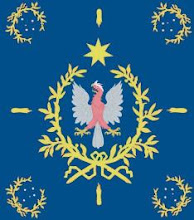
All Infantry Regiments carry one Parliamentary colour and one regimental colour in each battalion. The colours are 150cm square. The Parliamentary colours are deep blue with the national emblems displayed, always in gold and "natural" colours. The regimental colours have the field matching the regimental facings and embroidery matches the button colours. The Füß-Jäger Battalion does not carry colours. The pike staves are painted black and the finials are gilt or silvered, pierced with the stars of the Southern Cross. The cloth of the colours is wrapped around the staves and then nailed with gilt or silvered nails.


Parliamentary Colour used by all infantry regiments

A History of the Republic

In New Holland

Originally the republic was settled by the United Provinces (The Netherlands), following reports by a number of nearly ship-wrecked mariners of a large, uninhabited land below the Spice Islands. The Dutch intention was to set up a base by which they could intrude themselves into the closely guarded trade from south east Asia, particularly the Phillipines and China, and as a support to their colonies on the Spice Islands. They settled in the northwest of the continent, laying claim to the whole land.

Unfortunately the mild weather of July, 1667 was succeeded by the cyclone and storm ridden wet season of 1667-68, which virtually wiped out the young base. The Dutch government decided to abandon the base but some settlers, who had moved further inland and found success with farming cattle, pleaded to be allowed to stay. They established a town, Katerina, which they named after a well respected midwife and wife of one of the leading burghers, Katerina Zaagman. Over the next years the town existed as mainly a trading post and some times council meeting place. The original port, Heymel, was 220 miles to the north and few trade goods made their way south, the colonists priding themselves on their self-sufficiency.

As a consequence of the Franco-Dutch War (1672-1678) the Dutch were forced to cede one of their colonies to neutral power, as well as surrender parts of the Netherlands themselves. The unprofitable colony of New Holland was chosen and transferred to the Russian Empire, it being considered that the Russians would least threaten the United Provinces' power in the region. Although this was not what France nor the UK had intended, the matter was agreed and a Russian governor, Piotr Megorsky, and several shiploads of boyar families and serfs arrived at the beginning of 1679. The governor, seeing the sqalid port of Heymel as unsuitable and too prone to storms, moved south and set up residence at Katerina, which was renamed Ekaterinsburg.

However the heat and cost of running the unprofitable colony soon told and, in an attempt to curry favour with the northern German states and Denmark against Sweden (Russia's main rival in the Baltic), in 1685 Russia gifted the colony to the Duke of Oldenburg, who was also King of Denmark. Left behind when the Russian governor packed his bags were the serfs, many of whom had become defacto free settlers, and the 700 men of the 3rd Battalion, Permskiy Infantry Regiment, who had provided the colony with a vestige of a police and military force. Permskiy's uniforms set the tradition of the RNS infantry wearing Russian styles of uniform for the next century.

Denmark, already having trouble holding her overseas colonies, refused to have anything to do with the colony at the far ends of the earth. Equally, however, Denmark did not want to offend a potential ally against Sweden, especially after the disastrous Scanian War. So the colony was held only under the title of the Duke of Oldenburg and Danish citizens were forbidden to settle there. German and Austrian citizens were encouraged to settle with free land grants (often land claimed by the original Dutch settlers) on offer. The ties with the small states of Germany were born when the first German and Austrian colonists arrived in 1687.

Meanwhile, the rich fishing grounds and pearl beds had attracted large numbers of fishermen from the Spice Islands, Sultanates of Malaya and southern China. Heymel had not developed as a major port, but supported a sizeable population of fishermen and pearlers. They had been discouraged at first by the strict Dutch rule, but swarmed in with the more welcoming (and lower taxing) Russian administration. With them came merchants and mercenaries/body guards from India. Heymel was an interesting place to live (and be murdered, if you were not careful) during this time.

By 1689 the Oldenburg administration had managed to tame Heymel. But in the taming the profits which had been appearing again disappeared. Once again Neues Südland, as the land was now known, was a burden on its colonial masters. In order to ease the financial pain, a new infantry regiment was raised and offered for service with the Dutch, in the War of the Grand Alliance. The offer was accepted and the colony showed the first, and last, profit for the Duke of Oldenburg. The regiment, with recruits drawn from all the peoples of the colony, including the native Boori population, proved to be good fighters but hoplessly ill disciplined in quarters. So the two year contract was not renewed. In desperation the colony once again changed hands- gifted to the new King of England, William III, on his coronation in 1689.

William, fully ware of the limitations of the colony, nevertheless accepted the gift graciously- he saw an opportunity to dilute the flow of Jacobite sympathisers to the North American colonies. He encouraged the English and Scots to send their sons to the colony and also decided that troublesome Irish and Scots families, particularly supporters of the deposed Stuart dynasty, should be exiled there. Each family who agreed to passage was gifted 50 acres of land near Ekaterinsburg, while those who objected were sent as indentured servants.

By 1698 Europe was watching a new crisis develop. Charles II of Spain was without heir and it seemed he would bequeath his throne to Philip of Anjou, grandson of Louis XIV of France. Europe was faced with the possibility of France and Spain being united under the Bourbons. As part of a deal to persuade Philip not to take the throne, Neues Sudland (as it was now spelled) was offered as an alternative (along with several other less than profitable colonies). The deal failed but it did spark a deep unrest among the population, who were sick of the way they were traded among the great powers. When the English garrison was withdrawn to take part in the War of the Spanish Succession, in 1702, the colony revolted and declared itself independent. The UK, being otherwise involved and seeing no value in the colony, agreed on the proviso that the new republic would continue to accept transported families from Ireland and Scotland. The colony agreed and the Treaty of Excorporation was signed on 24 December, 1702.

In 1707 the mainly Irish and Scots peopled Eastern Marches joined Neues Sudland, having themselves used France's preoccupation with continental affairs to declare independence.
In 1708 David Kimberley, the 3rd son of a British jewellry merchant who had established an enormous cattle station (by European standards- the station was larger than Britain) 600 miles to the SW of Ekaterinsburg, found diamonds on his property. The influx of diamond prospectors found more deposits, but more importantly large mineral reserves were found. In 1710 gold deposits were also found at O'Connell in the Eastern Marches. European interests in the new nation increased significantly. Realising their isolation would not protect them by itself, the republic used their newly bulging treasury to dramatically increase the size of the armed forces. By 1715, recruiting parties were busy across Europe, promising veterans of the recent war land grants, wives (should they want one) and free passage to the republic, should they join the forces for 10 years service. Ladies of negotiable affection and war widows were also lured with promises of land and a husband, on the proviso they remain with that husband until his service expired. The many fishermen and pearlers living in the area of Darwin (formerly Heymel, but renamed after the first Anglican bishop appointed to the colony), were recruited as members of the new navy, as were the crews of visiting vesels.

By the time the great nations of Europe had recovered from their war, and were preparing for the next, the trouble of conquering the republic was thought to be greater than any gain that may be expected. The republic, in the meantime, had realised that the cost of keeping their troops trained and ready was more expensive than they had realised. The idea of renting their troops out would defray the costs of maintaining them and keep them battle tested. More importantly, it would also establish good relations with many nations, which the republic hoped would lead to allies, should any nation have plans of conquest.
In the Eastern Marches

Originally this area was settled by the French, who established several whaling and fishing ports on the coast. Tales of large tracts of reasonable farming land were brought home and some 100 French families had moved to the new land by 1661. Louis XIV then offered his "Wild Geese", the Scots and Irish followers of James Stuart, the opportunity to settle there. His plan had the merits of decreasing the amount of intrigue in play around his court and also removed a possible source of recruits from his rival Spanish and Austrian crowns. In 1691 the first colonists landed, led by one Terence Patrick O'Gabhain, a former captain in the Dillon Infantry. A sizeable contingent of French, mainly from Gascony and Burgundy, accompanied the Wild Geese on their migration.

The new colonists found the land to be both more fertile, but also more forbidding, than they had anticipated. For the Irish the large numbers of deadly snakes and spiders were especially daunting, but the area to the west of the mountains provided perfect land for growing wheat, barley and other cereals. The well watered coastal regions offered good land for dairy cattle and vegetable crops, such as potatoes and beet. In 1700 a Spanish ensign, John McArthur, was injured in a duel and forced to resign his commision. His family having managed crofters and shepherds, he brought some merino sheep with him from Spain and started wool production. The climate proved to be very suitable for such an enterprise and McArthur was soon joined by others.

The War of the Spanish Succession had an immediate impact on the colony. As the French treasury was being depleted by the war in Europe, taxes were being increased every time a new ship arrived from France. With no French troops to protect them, bar two companies of French militia guarding a penal colony at Port McQuarie ("The Devils Garden"), the settlers also had to deal with attacks from natives and raids by British and Dutch ships.

The settlers became restless. Very highly taxed, but with no benefits offered by France, dissatisfaction was growing.

In 1704 rumours started that the colony was to be transferred to the British crown as part of the war settlement. News of the successes of Eugene and Marlborough had reached the colony, so the rumours were believed. Two wealthy gentlemen from the RNS, Geoff Whitlam and Johannes Pietersen, started the rumours and then urged the colony to throw off the French crown and join the republic. In February 1705 the leading families asked the Governor for a reduction in taxes, hinting that refusal would see widespread unrest. The governor responded by bringing in four companies of troops, from French colonies in the Americas. The troops landed in December of 1706 and promptly arrested Whitlam, Pietersen and the men of the leading families around the capital, Roisoliel.

This sparked a general uprising. The colonists attacked the barracks and prison, freeing the men and causing some casualties to the troops. The governor was able to send a mesage to the penal colony at Port McQuarie, recalling the two companies of French militia based there as prison guards. The colonists withdrew when they landed.

Considering the uprising to have been broken, if not crushed, the governor gathered his six companies and planned his next moves. The hot summer months were considered to be inappropriate for European troops to conduct marches, so the governor paid the local tribes to raid the properties of those he considered to be the ringleaders. In doing so he inadvertently sent the natives against men who had been undecided about joining the rebellion. One of these, Murray O'Donnell, was an experienced senior officer, having served with both France and Austria. He promptly offered his services to the rebels and was accepted as their leader. Meanwhile Whitlam had sent messages to the RNS, asking for assistance.

The 4th (now McLeod) Regiment of Foot was sent to the colonists' aid in two ships, each carrying one battalion. One ship, the Khota Maru, struck the huge reef on the NE coast of the continent, half the troops being lost in the wreck. The rest made it ashore and began the long trek south, having running battles with both the natives and the forces of the Holy Kingdom, who objected to their passing through their lands. Short of weapons and ammunition, the troops were forced to surrender and were imprisoned, sparking yet more diplomatic turmoil between the the two nations.

The other ship, the Conchin, disembarked at Thirroul, south of Roisoliel, on 25th April, 1707. The battalion was met by O'Donnell and quickly marched north. On the march native scouts reported that the French troops, with a large body of unfriendly natives, were approaching. O'Donnell set up an ambush and the native scouts were able to dispatch their opposite numbers. Unwittingly the governor, the Marquis de la Perouse, marched into the ambush with five companies of troops and his two pieces of artillery. The RNS battalion, drawn up in the bush on the west of the road, stood up, advanced five paces and fired a devastating volley into the French column.

Losing 60 percent of their men, their CO and the governor, the French troops broke. The natives turned to attack but, immediately seeing the reality of the situation, all sat down and turned their backs to the carnage, signifying their having ceased hostilities. The French survivors were chased back to the capital, where an immediate assault of the governor's compound captured the remaining company of troops.

The ambush was grandly titled the Battle of Bulli.

On 01 July 1707 the Eastern Marches declared their independence from France and on 14 July 1707 the Treaty of Union with the RNS was signed.

The many colonists of French and Basque blood, who had settled in the cooler southern highlands of the colony, at first ignored the move to independence. But tensions rose with the first attempt by France to reconquer the Eastern Marches and, in 1712, the French population decided to attempt to break with the RNS and re-establish their area as part of France. A sharp skirmish, involving a battalion of the 5th (Robertson) Regiment of Foot and two squadrons of the 4th Dragoons, decided the colonists to strike south, though honours were even between the two forces. The colonists were hopeful that they could seize the nearly empty coastal area between Port Eden and Lakes Entrance. The savage reaction to their incursion by the Holy Mormoan Kingdom was unexpected and few survivors made the return to the Eastern Marches. They were more surprised to be welcomed back, cared for and given new land grants, not realising the RNS government was using their plight in an attempt to divert King Louis' attention towards the Holy Kingdom.

France had at first refused to recognise her colony's independence. Three attempts to bring their colony back under the crown were made in 1710, 1713 and 1717. The first two fleets had the misfortune to try to run the northern coast of New Holland in the month of December, with the result that the majority of the ships were sunk in storms. The survivors who reached the RNS were given simple choices- the officers could remain as colonists or return to France. The troops could join the RNS forces and receive land grants or be sent to work in the Kimberly mines. Nothing is recorded of the fate of those who landed in the unoccupied territories, though an officer who made his way to Java reported that the natives were both fierce and cannibals.

The 3rd fleet, bearing six battalions of infantry and eight guns, landed at Port McQuarie on 01 June 1717. At first the fleet seemed to have totally surprised the RNS with their appearance. They suffered no opposition as they sailed into port and could see the citizens of the town fleeing to the hills beyond the port. But as the troops were assembling on the docks after disembarking, they were raked by cannister from four guns hidden in warehouses near the docks. At the same time three battalions, two from the 3rd (now Townsville) and one from the 5th (Robertson) Regiments of Foot, opened fire from the streets and warehouses. The French, weapons not yet loaded, tired from a long sea voyage and having taken many casualties, laid down their arms. The usual terms were given and a special clause, deleting any reference to the 3rd Regiment being present (the French were shocked and ashamed to see that the majority of the troops who fired on them were female), was agreed to.

At this disaster the French crown admitted defeat, acknowledging that retaining the colony was beyond its current means. But the provisions that the RNS supply troops to support settler parties when required (at the usual rate of hiring those troops), the penal colony at Port McQuarie remain in operation until 1750 and that French settlers and troops be allowed to pass through the Eastern Marches to settle other areas, were demanded.

The RNS reluctantly agreed, albeit with the proviso that French troop numbers be limited to one regiment of infantry at any one time, and the Treaty of La Perouse was signed on 26 January 1718. The capital of the Eastern Marches was renamed O'Donnell, honouring the victor of Bulli.


Current Political Situation

The People's Party currently holds power. The President of the Parliament is Kelvin Rapp, of whom it is said "that when KRapp speaks, that's what you hear!". As usual, the Party's "Let's have a spend up!" philosophy has put severe strain on the nation's coffers, so agents of the government have been sent to Europe in order to look for employment opportunities for the regiments. There are also rumours of tax increases.

Currently the mining companies and banking houses have the greatest access to the government's ministers, as they did under the former Conservative government. However it is understood that they have dropped their call to have slavery reinstated, in order to reduce operating costs and make their products competetive overseas, though at least one banking house is demanding that debtors be placed in indentured servitude.

The major religions are again pushing to have influence on the government and are seeking to overturn the "Missionary Laws", which allow citizens who are disturbed by missionaries/clergy/evangelists knocking on their doors to beat the offender 15 times with a rattan cane. They are also seeking to have their churches exempted from taxation (currently set at the business rate) and the right to build places of worship outside the designated religious enclaves (known as the "Miracle Miles" by the citizens). With the population apathetic to these moves and the politicians not wishing to allow religion more power than it has, these moves are unlikely to succeed.

Over all the population is cynical about politics. At the last election Gerald Dixon, a notorious bushranger and highwayman, was elected by popular vote in the Rostov electorate. He refused this "honour", saying he may be a thief and scoundrel, but he was not a politician. The government promptly doubled the reward for his capture.

Neues Sudland

"Imaginations" are a fictional nations, generally set in the period 17C to early 19C, depicting imaginary nations used for wargames campaigns. Their main purpose seems to be to give an outlet for a gamer's creativity, allowing them to design armies free from the historical constraints for the design of uniforms, organisation, etc.

It's an interesting and fun way to spend some time. I've toyed with the idea of "Republic of Neues Sudland" for a while, spurred on by Henry Hyde's articles in Battlegames Magazine and the writings in Charles Grant's and Peter Young's books The War Game and Charge, respectively.

So far I've designed a few flags and have the basic uniform ideas set down. I haven't worked out the political details, etc, as yet. And the whole idea sits behind finising my SYW historical figures in terms of priority. But here's some of the things I've done. The templates for the uniforms are available from the excellent Not by Appointment blog. David, thanks for putting that on the net.


The Nation

The Republic of Neues Sudland is on the Indian Ocean, in the NW corner of New Holland, with enclaves in the east. Settled originally by the Dutch and Irish, it has since been traded between "great powers". In 1702, after their British masters offered to trade the nation as part of an abortive plan to avoid the War of the Spanish Succession, the people got sick of being pawns and broke away from their colonial masters. So the influences are German, British and Russian, with the language spoken being a mix of English, German and various Asian languages, due to the mix of people living there.

Having claimed the whole continent, despite the small population, the RNS is not happy that their claims have been ignored. In fact, the whole notion of "Unoccupied Territories" may surprise several colonial powers in Europe and Asia and particularly the Holy Kingdom of New Wales, which actually covers far more territory on the continent. The area the nation occupies is larger than Europe. But 50% of the 3 million citizens live within 20km of the capital, Ekaterinsburg, and 20% of the population lives in the Eastern Marches. So the population density is very low. The generally arid nature of the country exacerbates this low population density, though the Eastern Marches provide good, arable land and the NW of the continent supports large rice and cotton growing areas, due to the high seasonal rainfall.

The people themselves, being great fans of a cold beverage on hot days, like to believe that the name of their nation actually means "New Beer Land", so therefore believe that drinking beer is a patriotic duty. The RNS is a secular nation with no state religion. In fact, the RNS contains the largest proportion of agnostics and atheists in the civilised world- much to the horror of that civilised world.

The main income for the treasury comes from two sources- renting regiments out to other nations and from the metals gained from the many mines in the nation. The government is not adverse to renting units to both sides of a war and, in the past, regiments have fought against each other under foreign masters. Unfortunately this has led to some deeply entrenched rivalries and certain regiments cannot be garrisoned in the same area, for fear of brawling or even outright combat.

In particular the 1st Horse and 3rd Dragoons have to be separated by the width of the continent. So deep is their hatred of each other (since the 1st chased the 3rd off the field of Blasthoffen- and thereafter dubbed the 3rd Dragoons "The Sprinters") that over the past 15 years more men from these regiments have been killed in duels than have died in battle. Similarly, when the Longhai Regiment of Foot found the 2nd Regiment of Horse crossing their front during the action at Launceston, they took the opportunity to exact revenge for a previous occasion, during a war when the regiments were in the employ of the opposing Princelings, when the cavalry had charged them, causing no small number of casualties and capturing the regiment's Parliamentary Colour. The volley they fired was very effective, emptying most of the saddles of the two nearest squadrons. It was unfortunate that, at the time, the regiments were both in the employ of the Grand Duchy of Van Demon's Land. That fine, but inappropriate, volley saw the Duchy defeated and forced to join the Holy Kingdom of New Wales.
The nation is supposedly a parliamentary democracy. However, as the candidates for parliament are chosen by vested business interests, not the members of the political parties (Conservatives, known also as "The Big End of Town", and the People's Party, known as "Corruption Central"), the reality is far removed from the theory. It is this emphasis on profit at all costs that sees the RNS troops serving anywhere, at any time, if you have the cash.

There is no bar to anyone of any ethnic background serving in the republic's army. Indeed, if a regiment has been hired for service then anyone, of any nationality, is likely to be "persuaded" to join the colours. The bar on wearing traditional items of clothing or facial hair, such as Sikh turbans or beards, has restricted the availability of some recruits. Citizens of European background are preferred for the cavalry and artillery while natives and those of Pathan, Turkish or Afghan extraction are most often found in the infantry. Despite the relaxed relations between the races in the republic, the majority of recruits are still of Irish, Scots or Germanic extraction, lured by the promise of land at the end of their service.

The RNS is unusual in that one infantry regiment, the 3rd "Townsville" Regiment of Foot, is composed entirely of female soldiers. All the officers, of course, are male and service in this regiment is very sought after, despite it offering little social advantage to the ambitious officer. The regiment has gained a notorious reputation in battle, generally offering no quarter to captured enemies and being particularly tenacious when defending their ground.

Officers are usually chosen on the basis of political favouritism or by buying a commission. As membership of certain regiments allows entry into the highest social circles, commissions are sought after and traded like any other commodity. The only prerequisite is that the officers are fluent in at least German and English, that they are literate and that they have sufficient income to pay their mess bills. Once commissioned, the ambitious officer must serve a minimum of three years in that rank before purchasing the next higher rank. Once at the rank of Major, promotion can only be attained by passing examinations and being recommended by the Council of Generals, which consists of all retired general officers who may still be considered to be of sound mind.

Although RNS will hire to any nation, they still maintain a certain sympathy for the nations of southern and western Germany, from where many of the leading families have come. There is also a deep affection for serving with the United Kingdom, as many young English gentlemen find commissions to be both cheaper to purchase than in His Britannic Majesty's army, and service far more profitable.

After 10 years service an officer is granted a "selection", of 25 to 150 acres (depending on rank), on which they may build a house and farm. Any troops that survive 25 years service may also apply for a 10 acre land grant, should they have honourably served the army.
Any man or woman who captures a colour (not an RNS colour, should two regiments meet in battle) or general officer is granted 50 acres of prime land in the Eastern Marches.
Domestically the RNS is often involved in skirmishes with neighbouring territories. The RNS' refusal to recognise any sovereignty over the continent, other than their own, is a constant source of conflict.